
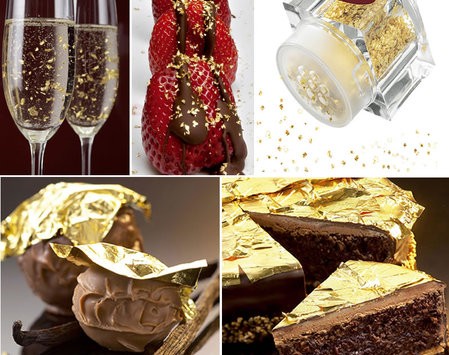
Our ancestors believed that gold is divine metal. They thought consuming it will give them more power. Now, it’s prestige and luxury to eat gold. Sound fancy enough?
Gold is nontoxic when pure; it is used in certain food items, a lot of recipes and garnishing requires the addition of gold. In the luxury food industry, it is used in the form of powder, leaves, flakes or sprinkles.
A gold leaf, flake, or dust is consumed for certain gourmet foodstuff; mostly they are used in sweets as a garnishing ingredient. It is used to decorate traditional pastries and it is served at weddings and religious festivals.
In China, certain types of venison are sprinkled with gold, and in Japan, it is usual to exchange good wishes for the New Year over a cup of sake containing gold. Some of Japan’s best chefs garnish their best sashimi with fine gold. Also in Pakistan, gold is sometimes consumed for its supposed stimulating properties.
In some regions of Medieval Europe, the nobles used gold flake as a garnishing item in foodstuff and beverages, in the shape of a leaf, as a flake and sometimes as dust.
France and Switzerland, popular chocolate artisans decorate their truffles, a magical experience for the taste buds, with fragments of gold leaf. Furthermore gold flake has been seen as a valuable and exceptional material with health benefits. Gold can be used to decorate cupcakes, cakes and tortes to make the served dish look glamorous. It will give the items a more wonderful and luxurious look.
The use of gold in such a manner shows and signifies the wealth owned by the crowd. It is also treated as a status symbol. Furthermore, it has been seen as a valuable and exceptional material with health benefits, according to legends.